
TFG – South African trademarks
Updated 8 November 2026
TFG (The Foschini Group) is a JSE-listed fashion and lifestyle retailer. Its chains include Foschini, Markham, Totalsports, @home, Jet and Sportscene.
How TFG has built and protected its brands in South Africa – its trademark portfolio, where it expanded, how quickly its marks are registered, and who it competes with.
Download report (PDF)TFG trademarks in 45 seconds

Watch the video on its own page, with transcript – https://snz.co.za/trademark-country-selection-direct/tfg-south-african-trademarks/overview-video.html
A portfolio built over time
TFG filed its first South African trademark in 1952 and has filed 767 since; its busiest year was 2019, with 104 new filings. The chart shows its filings per year from 1970.
Trademarks by filing year, up to 2024; applications still pending are not included.
The names behind the portfolio
Over the years the group has filed under several names – earlier company names, holding companies and subsidiaries. We count them together.
| Name | Marks | Filing years |
|---|---|---|
| TFG | 940 | 1952–2025 |
| Foshini Retail Group | 4 | 2000–2012 |
Where TFG expanded its business
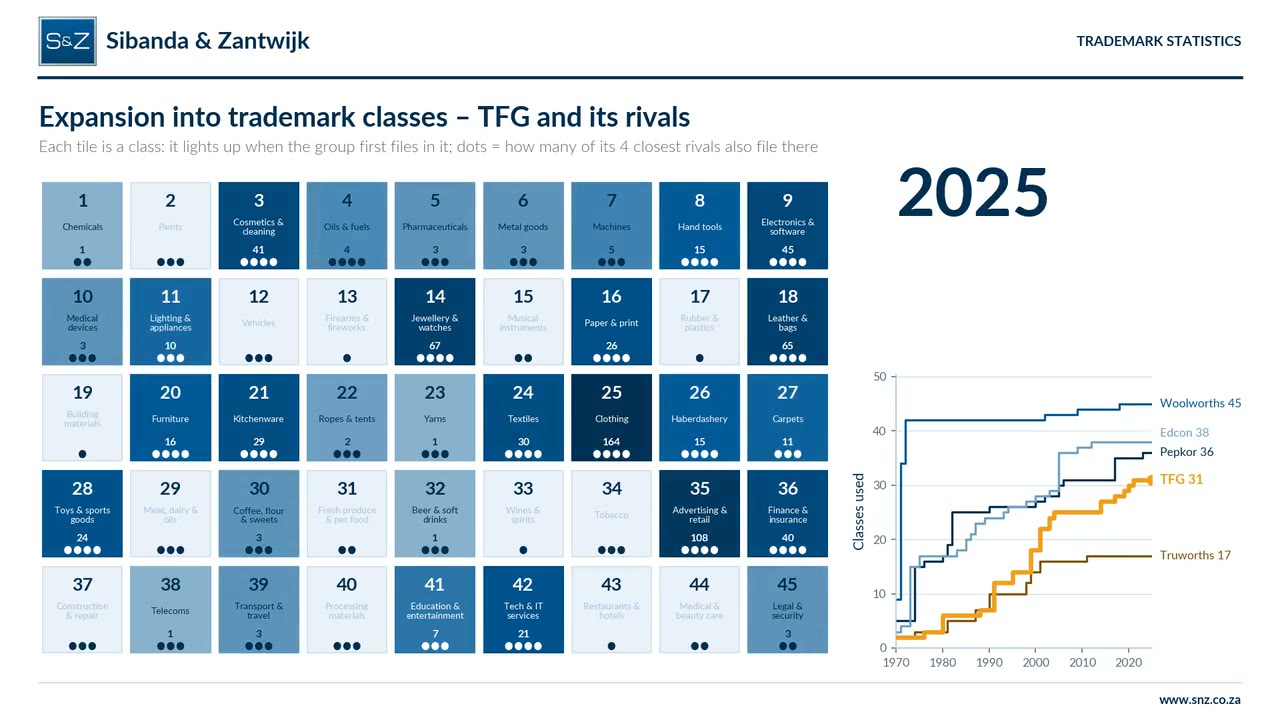
Trademark classes show what a business sells. TFG's portfolio is concentrated in clothing (class 25), advertising & retail (class 35), jewellery & watches (class 14). Its most recent moves were into beer & soft drinks (2021), medical devices (2020), pharmaceuticals (2019).
TFG trademarks: expansion into trademark classes, 1970–2025
Watch the video on its own page, with transcript – https://snz.co.za/trademark-country-selection-direct/tfg-south-african-trademarks/class-expansion-video.html
Each tile is a class; it lights up when the group first files in it and darkens with more filings; the dots show how many of its closest rivals also file in that class. The chart compares the number of classes used with its rivals. The video runs from 1970; classes entered earlier are lit from the start.
| Class | Marks | Share | Since |
|---|---|---|---|
| 25 Clothing | 164 | 21.4% | 1953 |
| 35 Advertising & retail | 108 | 14.1% | 1995 |
| 14 Jewellery & watches | 67 | 8.7% | 1952 |
| 18 Leather & bags | 65 | 8.5% | 1991 |
| 9 Electronics & software | 45 | 5.9% | 1988 |
| 3 Cosmetics & cleaning | 41 | 5.3% | 1991 |
| 36 Finance & insurance | 40 | 5.2% | 1999 |
| 24 Textiles | 30 | 3.9% | 1980 |
The brands TFG protects most
The word marks and logo names TFG has filed most often – the same brand filed in more classes, in more versions or again over the years.
| # | Brand | Trademarks | Classes | Filed |
|---|---|---|---|---|
| 1 | JET | 28 | 20 | 1976–2019 |
| 2 | AH | 14 | 14 | 2024–2024 |
| 3 | BASH | 14 | 14 | 2022–2022 |
| 4 | IMAGINE MORE | 14 | 14 | 2017–2017 |
| 5 | @HOME | 13 | 13 | 1999–2001 |
| 6 | DUE SOUTH | 12 | 12 | 2003–2003 |
| 7 | DUESOUTH LIFE IN THE OPEN | 12 | 12 | 2016–2016 |
| 8 | JET LOVE WHERE YOU LIVE | 11 | 11 | 2021–2021 |
| 9 | JET LIL STAR | 11 | 6 | 2019–2020 |
| 10 | FOSCHINI | 9 | 9 | 1983–1991 |
| 11 | JET HOME | 9 | 9 | 2014–2014 |
| 12 | TOTALSPORTS | 9 | 5 | 1981–2011 |
| 13 | ICONOGRAPHY | 8 | 6 | 2022–2022 |
| 14 | FABIANI | 7 | 7 | 1966–2019 |
| 15 | FASHION AND ME | 7 | 7 | 2016–2016 |
Logos filed most often (since 2020)









TFG's logos
The 42 different logos TFG has had published since 2020 – each logo shown once, however many classes or versions it was filed in. Logos protected in more classes come first.
























How quickly its trademarks are registered
Over the last five years, TFG's marks took a median of 2.8 years from filing to registration, slower than the market's 2.7 years. Most of that time is examination: 1.8 years from filing to acceptance (market: 1.9). Registration itself follows about half a year after acceptance.
Median years from filing to registration per registration year, split into examination (filing → acceptance) and acceptance → registration; the dashed line is the market median. A high recent value means older applications came through that year.
Who files the most in TFG's classes
Ranked by number of trademarks filed in TFG's main classes – any company that files there, whatever else it does (including retailers' own brands). This shows TFG's market position, not who is most like it.
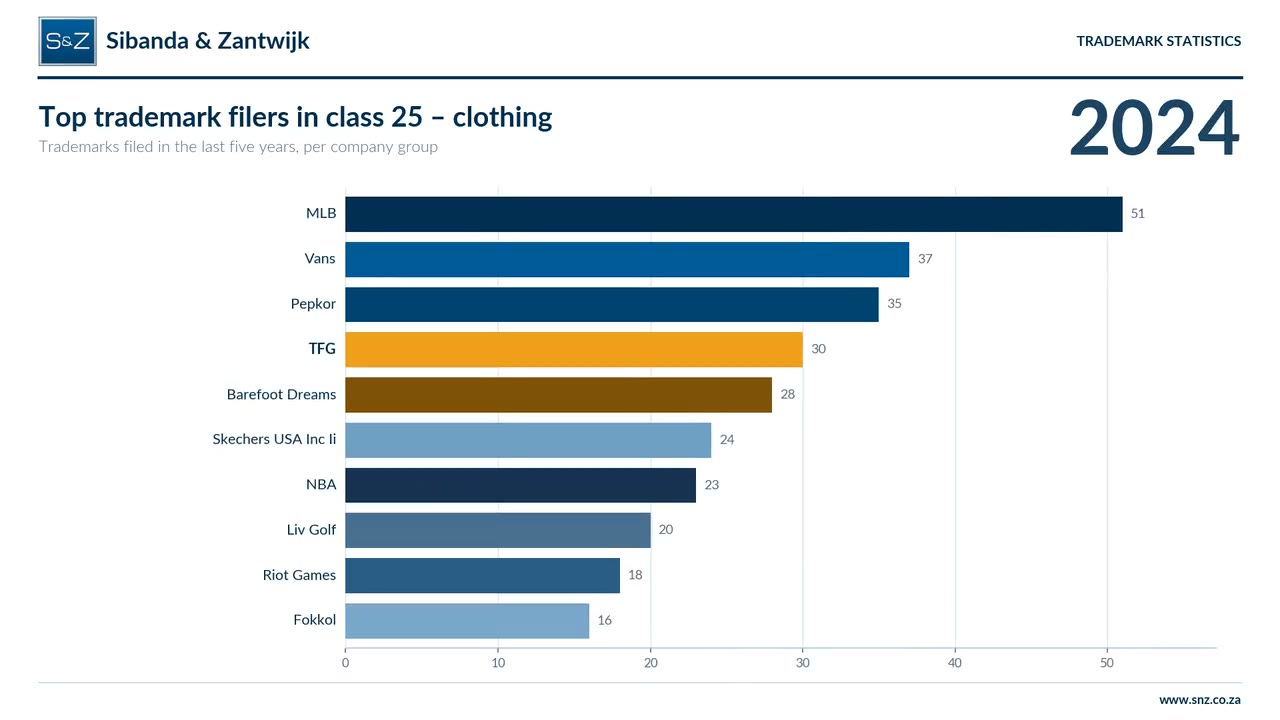
In the last five years, TFG was #4 of 2,715 filers in class 25 (clothing), with 30 of 4,647 trademarks; #30 of 5,866 filers in class 35 (advertising & retail), with 19 of 11,124 trademarks; #11 of 406 filers in class 14 (jewellery & watches), with 10 of 778 trademarks.
TFG's share of all trademarks filed in each of its main classes, per filing year.
Top trademark filers in class 25 (clothing), South Africa 1975–2024: TFG
Watch the video on its own page, with transcript – https://snz.co.za/trademark-country-selection-direct/tfg-south-african-trademarks/class-25-race-video.html
Main competitors – the companies most like TFG
Ranked by how similar their whole trademark portfolio is to TFG's – the same mix of classes and the same words in their marks – not by size. Large filers in its classes that do something different rank lower here.
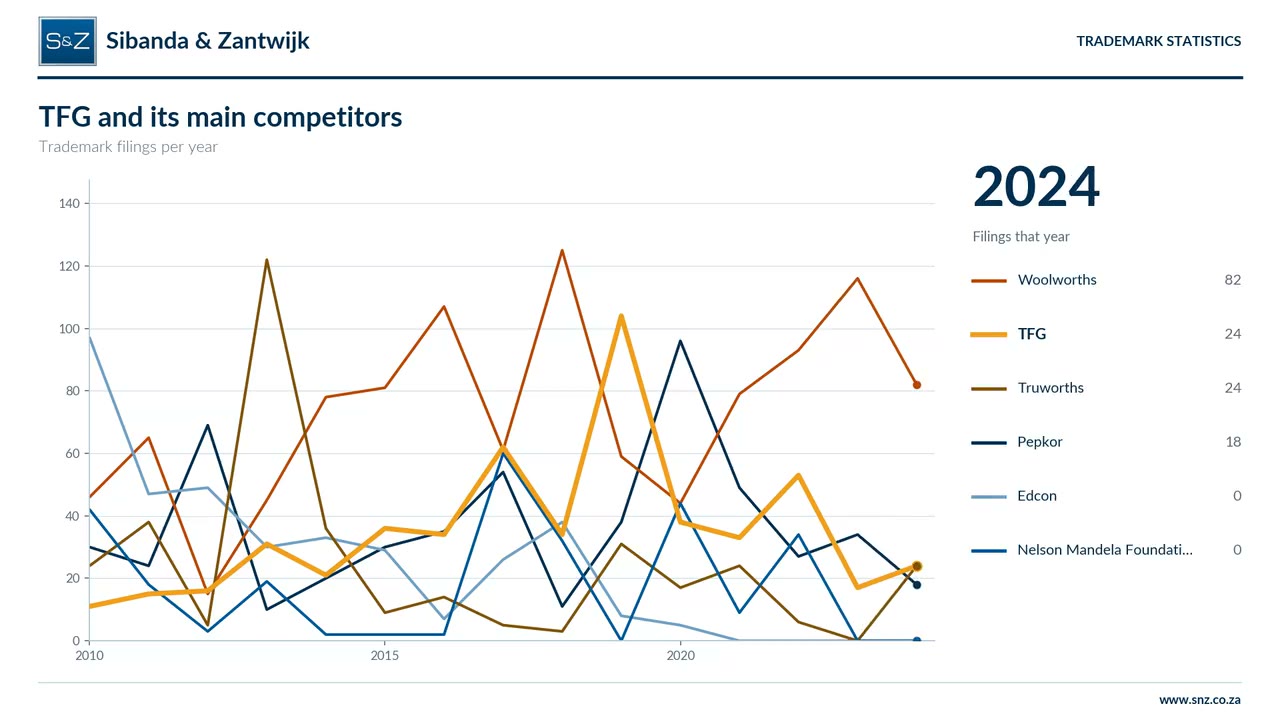
TFG's closest competitors in South Africa are Pepkor, Woolworths, Edcon and Truworths.
TFG trademarks vs competitors: filings per year, 2010–2024
Watch the video on its own page, with transcript – https://snz.co.za/trademark-country-selection-direct/tfg-south-african-trademarks/competitors-video.html
Trademark filings per year: TFG (orange) and its five closest competitors.
| # | Company | Relationship | Similarity |
|---|---|---|---|
| 1 | Pepkor | Direct competitor | 77% |
| 2 | Woolworths | Direct competitor | 70% |
| 3 | Edcon | Direct competitor | 67% |
| 4 | Truworths | Direct competitor | 67% |
| 5 | Nelson Mandela Foundation Trust | Supplier / brand owner | 71% |
| 6 | BMW | Supplier / brand owner | 70% |
| 7 | Red Bull | Supplier / brand owner | 69% |
| 8 | South African Rugby Union | Supplier / brand owner | 66% |
| 9 | Porsche | Supplier / brand owner | 66% |
| 10 | Netflix | Supplier / brand owner | 66% |
Similarity of trademark activity since 2015 (classes and words used in marks). Retailers appear where their own brands compete on the shelf.
TFG – relevant export countries
South Africa exported US$49.8 billion of the goods TFG's main classes cover in the last year – clothing; footwear; headwear; headgear (class 25); jewellery; precious stones; precious metals; horological and chronometric instruments (class 14); bags; umbrellas; luggage; clothing (class 18); computer software; computers; optical; apparatus and instruments (class 9); cosmetics; essential oils; dentifrices; perfumery (class 3). Combining where these goods are exported, imported, growing and made (and copied), and what protection costs, these are the markets where TFG's trademarks matter most.
Where South Africa exports TFG's top goods
TFG's trademarks most often cover clothing, bags, jewellery and cosmetics. South Africa's ten largest export markets for these goods took 78% of its exports of them in 2024.
South Africa's exports of each good to the country in 2024 (US$ million). The goods are the ones TFG's specifications mention most in its main classes; the figures are national exports, not the company's own sales.
Adjust the weightings
These weightings decide how the countries below are ranked. Change any value and the others adjust to keep the total at 100%.
Worldwide
| # | Market | Score | SA exports | Import growth / yr | Route | Cost, 5 classes |
|---|---|---|---|---|---|---|
| 1 | United Kingdom | 79 | US$8.6 billion | +9% | National | US$1,371 |
| 2 | United States of America | 73 | US$4.1 billion | -3% | National | US$3,425 |
| 3 | European Union | 73 | US$3.1 billion | -1% | National | US$2,388 |
| 4 | India | 72 | US$6.6 billion | +9% | National | US$1,295 |
| 5 | Japan | 68 | US$3.6 billion | -2% | National | US$1,774 |
| 6 | China | 66 | US$13.2 billion | -10% | National | US$1,224 |
| 7 | Hong Kong SAR | 65 | US$1.6 billion | +15% | National | US$1,715 |
| 8 | Singapore | 60 | US$565 m | +3% | National | US$2,144 |
| 9 | Türkiye | 60 | US$66 m | +4% | National | US$1,258 |
| 10 | Australia | 58 | US$357 m | -1% | National | US$2,380 |
Africa
| # | Market | Score | SA exports | Import growth / yr | Route | Cost, 5 classes |
|---|---|---|---|---|---|---|
| 1 | Nigeria | 53 | US$12 m | -16% | National | US$1,015 S&Z |
| 2 | OAPI (17 states) | 52 | US$19 m | -0% | National | US$1,563 S&Z |
| 3 | Malawi | 47 | US$17 m | +7% | ARIPO | US$450 S&Z |
| 4 | Kenya | 41 | US$19 m | -14% | National | US$3,095 |
| 5 | Mauritius | 41 | US$15 m | -8% | National | US$1,154 |
| 6 | Gambia | 40 | US$1.7 m | +19% | ARIPO | US$450 S&Z |
| 7 | Uganda | 40 | US$406 m | +167% | ARIPO | US$450 S&Z |
| 8 | Ethiopia | 39 | US$1.8 m | +2% | National | US$2,195 |
| 9 | Algeria | 39 | – | +14% | National | US$1,445 |
| 10 | Lesotho | 39 | US$84 m | +0% | National | US$326 |
SA exports = South Africa's exports of these goods to the market in the last year. Ranked with the default weightings. Score 0–100 from South Africa's exports of the goods to the market, net imports, import growth, foreign trademark filings, where the goods are made, market size and the cost of protection. Costs are total fees (official and professional) to file in 5 classes; ARIPO costs are per country, plus US$301 once per ARIPO application; S&Z = S&Z's own all-in price. Goods are taken from the classes and specifications, so the ranking is indicative.
Trade data: CEPII BACI (version 202601, trade flows 2022–2024), Licence Etalab 2.0; aggregated and combined with other data by S&Z.
Protecting its top brands in Nigeria and OAPI with S&Z
| Brand | Classes | Nigeria | OAPI (17 states) |
|---|---|---|---|
| JET | 20 | US$4,060 | US$4,333 |
| AH | 14 | US$2,842 | US$3,225 |
| BASH | 14 | US$2,842 | US$3,225 |
| IMAGINE MORE | 14 | US$2,842 | US$3,225 |
| @HOME | 13 | US$2,639 | US$3,041 |
S&Z all-in prices per brand in its number of classes, filing to registration.
TM Country Selection Rank the countries for your own goods and get the quotes.
Word marks you may have considered opposing
For TFG's five most-filed brands: word marks of other companies (not TFG's own group) that our similar word mark search, SimTM, found in the brand's own classes, and that we consider confusingly similar – from the earliest match found to today.
Similar to JET (classes 9, 14, 18, 25, 35; searched 2018-02-28 to 2026-11-07)
No confusingly similar marks of other companies found in this period.
Similar to BASH (classes 9, 14, 18, 25, 35; searched 2023-05-31 to 2026-11-07)
No confusingly similar marks of other companies found in this period.
Similar to IMAGINE MORE (classes 9, 25, 35; searched 2018-01-31 to 2026-11-07)
No confusingly similar marks of other companies found in this period.
Similar to @HOME (classes 9, 25, 35; no close matches in the search)
No confusingly similar marks of other companies found.
Similar to DUE SOUTH (classes 9, 18, 25, 35; no close matches in the search)
No confusingly similar marks of other companies found.
Similarity of the words only. Whether a mark could have been opposed depends on the goods and services, the reputation of the brand and the facts – S&Z can advise. New marks like these are what SimTM watch reports as they are published.
How S&Z can help you
S&Z does not just file trademarks. We are a technology-first firm that manages trademarks – analysing your data, monitoring competitors and making sure your trademark assets remain protected.
We manage your trademarks – not just file them
Analysing your data, monitoring competitors and making sure your trademark assets remain protected:
Filing and renewal at fixed, all-inclusive prices
S&Z prices – South African trademarks
| Filing, first class – incl. official fee, examination report, routine office action, acceptance, publication, registration and e-certificate | US$240 |
| Each additional class of the same mark, filed at the same time | US$225 |
| Renewal online, per class (every 10 years from filing) | R1,027 ≈ US$62.29 |
Renewal in rand; US$ at R16.49 per US$.
TFG's next five years of renewals
338 of TFG's registered marks reach their ten-year renewal date in 2027–2031. Renewed online with S&Z, that costs about US$21,053 over the five years.
TFG: frequently asked questions
What should TFG consider for its trademarks?
- Where to file next: its goods sell strongly in Nigeria, OAPI (17 states) and Malawi – markets where South African exports of the same goods are large or growing, and where S&Z files at its own all-in prices (see “TFG – relevant export countries”).
- Possible gaps: its competitors also protect class 34 (tobacco), class 31 (fresh produce & pet food) – worth checking against what the business sells or plans to sell.
- Fewer new brands: new brand names fell from 22.8 to 8.8 a year – worth reviewing whether planned launches are being protected early enough.
- Renewals and use: keep track of the ten-year renewal dates and of marks that are no longer used – unused marks can be challenged after five years, and some may no longer be worth renewing.